
Quick Answer
Does a transfer on death deed avoid probate on a Hawaii home?
For the house itself, yes. Hawaii adopted the Uniform Real Property Transfer on Death Act as HRS chapter 527, and the deed is nontestamentary, so the property passes to your named beneficiary at death. It has to be recorded before you die. It does not clear the mortgage, the liens, or the estate’s creditors.
By Aksana Tupalskaya | November 12, 2026
A transfer on death deed moves title. It does not clean it. The beneficiary takes the Oahu property subject to every mortgage, lien, and contract already on it, with no covenant or warranty of title, and that is written into the statute rather than left to a title company’s discretion.
What Chapter 527 Actually Does
Hawaii’s version took effect July 1, 2011, and applies to deeds executed at any time by a transferor who dies on or after that date. The requirements are short. The deed has to carry the essential elements and formalities of a recordable inter vivos deed, it has to state that the transfer to the beneficiary happens at the transferor’s death, and it has to be recorded with the Bureau of Conveyances or filed with the Assistant Registrar of the Land Court before the transferor’s death.
That last condition is the one that fails. A signed, notarized, unrecorded transfer on death deed found in a drawer after a death does nothing at all.
Capacity is the same standard as making a will, under HRS 527-8. No notice to the beneficiary, no delivery, no acceptance, and no consideration are required, under HRS 527-10. You can name someone who never finds out.
| The Question Owners Ask | What Chapter 527 Says | What It Means When the House Sells |
|---|---|---|
| Does it keep the house out of probate? | HRS 527-7 makes the deed nontestamentary, and HRS 527-13(a) passes the interest at death per the deed | No probate petition for the house itself, which is the whole point of the tool |
| Can I change my mind later? | HRS 527-6 makes it revocable; HRS 527-11 allows only a later transfer on death deed, an express instrument of revocation, or an inter vivos deed that expressly revokes | The revoking instrument has to be acknowledged after the deed and recorded before death, and tearing up the deed does nothing |
| Can I still sell or refinance while I am alive? | HRS 527-12 says the deed does not affect your right to transfer or encumber the property | You sell normally, and the beneficiary has no interest and no consent to give |
| What does the beneficiary receive? | HRS 527-13(b) takes the property subject to all existing conveyances, encumbrances, assignments, contracts, mortgages, and liens; HRS 527-13(d) gives no covenant or warranty of title | The mortgage follows the house, and a title search still has to be cleared before closing |
| Can the estate’s creditors reach it? | HRS 527-15 allows the estate to enforce liability against the transferred property if the probate estate cannot pay allowed claims or statutory allowances, with 18 months to begin proceedings | Escrow and the title insurer will care about that 18 month window on an early sale |
| Is the deed itself taxed when recorded? | HRS 247-3 exempts a document or instrument that conforms to a transfer on death deed from conveyance tax | The conveyance tax appears when the beneficiary sells, not when the deed is recorded; recording is $41 in the Regular System and $36 in Land Court |
What this tells me as the numbers agent for Oahu sellers: this deed is a cheap, clean answer to one narrow question, who holds title tomorrow, and it answers nothing about debt, taxes, or whether two beneficiaries will agree on a listing price.
The Property Tax Piece Nobody Mentions
The Honolulu home exemption does not ride along with the deed. It applies only to property owned and occupied as the owner’s primary home, and the Real Property Assessment Division requires a new claim when ownership changes. A beneficiary who lives on the mainland does not qualify at all.
The reporting step is the part that carries a penalty. When an owner dies, the surviving title holder, beneficiary, trustee, or authorized representative has to notify the division within 30 days or by November 1 of that year, using the Change of Status form. The division’s own guidance states a $300 penalty for failing to report, plus possible rollback penalties back to the effective date.
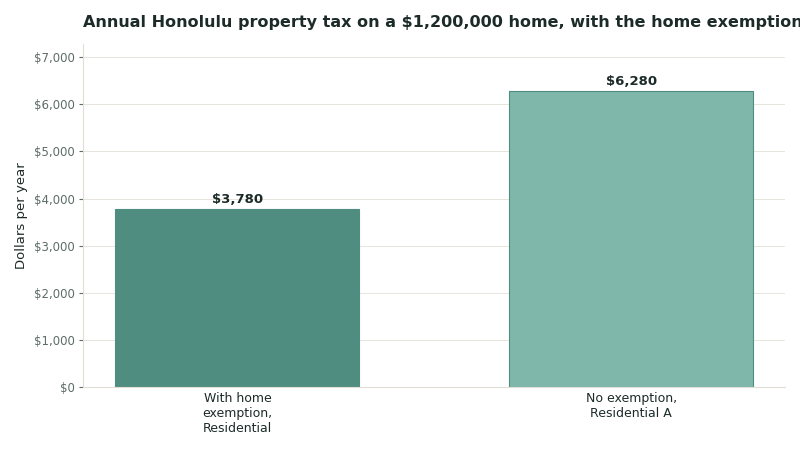
Then the classification shifts. Losing the home exemption on a single family house or condominium assessed at $1,000,000 or more moves it into the Residential A class, which is tiered. For the tax year running July 1, 2026 to June 30, 2027, the City and County of Honolulu rates per $1,000 of net taxable value are $3.50 for Residential, $4.00 for Residential A tier 1 on the first $1,000,000, and $11.40 for Residential A tier 2 above that.
Put a $1,200,000 Oahu home through both. With the current $120,000 home exemption, net taxable value is $1,080,000 at $3.50, which is $3,780 a year. With no exemption in Residential A, the first $1,000,000 at $4.00 is $4,000 and the next $200,000 at $11.40 is $2,280, for $6,280 a year. The gap is $2,500 a year on the same house.
A claim filed on or before September 30 takes effect for the tax year beginning the following July 1. The division’s guidance notes that an inheritance or purchase recorded after that deadline generally leaves the property in Residential A for the current and upcoming tax year even if a claim is filed. If the beneficiary will live in the home, read how the home exemption works on an inherited Oahu home before the deadline, not after.
A transfer on death deed is an estate planning document with an income tax shadow, so have a Hawaii estate planning attorney draft it and a CPA tell you how the transfer lands on your own return. Both are cheaper than the alternative.
What a Beneficiary Has to Do Before They Can Sell
Title has to show them as the owner before escrow can convey anything. For Oahu property where any portion is registered in Land Court under chapter 501, HRS 527-13(a)(1) requires a petition noting the death of the transferor and requesting a new certificate of title in the beneficiary’s name to be filed and processed with the Land Court before the interest is transferred. The statute sets no deadline for it, which is not the same as fast.
Pull the deed and check which system the property sits in before you assume anything. Oahu has parcels in both the Regular System and Land Court, sometimes on the same street, and the Land Court path adds a court filing to a sale that otherwise would not have one.
If two or more beneficiaries were named, HRS 527-13(a)(3) gives them equal and undivided shares with no right of survivorship, and HRS 527-13(a)(4) sends a lapsed share to the others in proportion to their interests. Every one of them signs the listing and the deed. A beneficiary who does not survive the transferor takes nothing, because HRS 527-13(a)(2) makes the interest contingent on surviving.
Then the ordinary Oahu seller obligations arrive. The mortgage is still on the house. HARPTA withholding of 7.25 percent of the amount realized applies to the sale unless the seller delivers a valid Form N-289 to the buyer, and a beneficiary living out of state usually cannot. Conveyance tax is owed by the seller at recording. The 18 month creditor window in HRS 527-15 is a question a title insurer may raise on a sale soon after the death.
Basis is the piece worth getting right in writing. What the beneficiary’s basis is on a transfer at death drives the gain, and the gain drives the tax, so it belongs in front of a CPA with the actual deed in hand. The reason it matters commercially is covered in why the date of death value of an inherited Oahu home matters. Run your own numbers with your own payoff and your own closing costs.
Frequently Asked Questions
Does a transfer on death deed have to be recorded before death?
Yes. Chapter 527 requires the deed to be recorded with the Bureau of Conveyances, or filed with the Assistant Registrar of the Land Court as applicable, before the transferor’s death. An unrecorded one accomplishes nothing, no matter how carefully it was signed.
Can my will override a transfer on death deed?
HRS 527-11 lists only three instruments that revoke one: a later transfer on death deed, an express instrument of revocation, or an inter vivos deed that expressly revokes. A will is not on that list, and the revoking instrument also has to be recorded before death. Ask the attorney who drafted your will to look at both documents together.
Does a transfer on death deed protect the house from my creditors?
No. HRS 527-12 says the deed does not affect the interest of a secured or unsecured creditor or future creditor of the transferor, whether or not the creditor has notice of it, and HRS 527-15 lets the estate reach the property for allowed claims if the probate estate falls short.
Is a transfer on death deed better than a living trust for an Oahu home?
It is narrower and cheaper. It handles one parcel and names who gets it, while a funded revocable trust can hold multiple assets, name a successor trustee who can sign during incapacity, and give escrow a single signer. I compare the selling side of the trust route in selling an Oahu home held in a living trust.
Can the beneficiary sell right away?
Once title reflects them, yes, subject to the Land Court petition if the parcel is registered there, the existing mortgage, and whatever the title insurer wants to see about the 18 month creditor window. There is no statutory waiting period in chapter 527 itself.
More resources on this topic
Why the Date-of-Death Value Matters When You Sell an Inherited Oahu Home. When you inherit an Oahu home, your tax basis usually resets to its value on the date the owner died, not what.
Staging an Oahu Home You Can't See in Person: What Remote Sellers Should Know. Staging can be coordinated fully remotely through video walkthroughs and a local team. Staged homes see a 5-15%.
Moving a Parent Into Care on Oahu? Here's What Happens to Their Property Tax Exemption. If your parent is moving into a licensed Oahu care facility, their home exemption can usually stay in place.
What Happens to a Reverse Mortgage When You Inherit an Oahu Home. A reverse mortgage becomes due when the owner dies, but Oahu heirs are never on the hook for more than 95.
A transfer on death deed answers who holds title and leaves the mortgage, the property tax classification, and the HARPTA filing exactly where they were. I sit down with owners and beneficiaries on a 20 minute remote call and map what the Oahu sale will actually require, in what order, so nothing lands as a surprise at escrow. Get it at islandlivingoahu.com/strategy.