

Quick Answer
If I carry the financing on my Oahu sale, is HARPTA still 7.25 percent of the full price?
Yes. HARPTA withholds 7.25 percent of the amount realized, and the amount realized is the sales price, not the cash you collect at closing. On an agreement of sale the Department of Taxation lets the withholding follow each principal payment. Everywhere else, Form N-288B filed at least 10 working days before the transfer date is the practical answer.
By Aksana Tupalskaya | November 12, 2026
The trap is arithmetic, not law. You agree to carry paper so the buyer can close, you collect a down payment, and the withholding is still calculated on the whole price. On a $900,000 Oahu sale with $150,000 down, that is $65,250 of withholding against $150,000 of cash, before commissions, conveyance tax, or your mortgage payoff touch it.
What the Amount Realized Includes
HRS 235-68(b) requires the buyer to deduct and withhold a tax equal to 7.25 percent of the amount realized, and makes the buyer liable for it. The buyer is the withholding agent, not you, which is why a buyer’s lender or escrow officer will not let this slide.
The Department of Taxation’s Tax Facts 2010-1, revised April 2025, is direct about the measure: generally the amount realized is the sales price, and it also includes the fair market value of property you receive and any liability the buyer assumes or that the property is subject to. The Department’s own worked example turns $3,000 in cash plus an assumed $1,500,000 mortgage into an amount realized of $1,503,000.
Read that twice if you are planning a wrap or an assumption. The note you take back and the loan the buyer takes over are both inside the number the 7.25 percent is applied to.
Hawaii has one instrument that the Department treats differently, and it matters here. An agreement of sale is an installment instrument where you keep legal title and the buyer pays you over time. Tax Facts 2010-1 says HARPTA applies to all agreements of sale regardless of when they were signed, that it must be withheld on each payment the buyer makes to you, that the requirement applies only to amounts attributed to principal and not to interest, and that withheld amounts are due to the Department by the 20th day after payments are made.
| How You Structure the Carry | When the 7.25 Percent Comes Out | What You Have to Do About It |
|---|---|---|
| All cash to you at closing | Once, on the amount realized, reported within 20 days of the transfer date | Nothing, unless you qualify for an exemption and hand the buyer Form N-289 |
| Agreement of sale, you keep legal title | On each principal payment, due by the 20th day after each payment is made | Interest is not withheld on, so the payment split has to be documented every year |
| Agreement of sale, parties agree otherwise | Tax Facts 2010-1 allows an agreement to withhold on the entire amount realized instead | Both sides have to agree to it, and you want it in the escrow instructions, not a handshake |
| Title passes at closing and you take back a note and mortgage | The amount realized is the full price, not your down payment | File Form N-288B before closing on the insufficient proceeds ground; the instructions name a purchase money mortgage as proceeds in a form other than cash |
| Buyer assumes your existing loan as part of the price | The assumed balance is inside the amount realized | Run 7.25 percent on price plus the assumed balance, not on your cash, before you sign anything |
| You carry paper and the cash at closing will not cover the withholding | Still due from the buyer as withholding agent | Form N-288B is the only documented route, and the Department adjusts the amount rather than waiving it unless there is no gain |
What this tells me as the numbers agent for Oahu sellers: the structure you pick does not change the 7.25 percent, it only changes when the state takes it, and only one of these rows gives you a filing that can lower it.
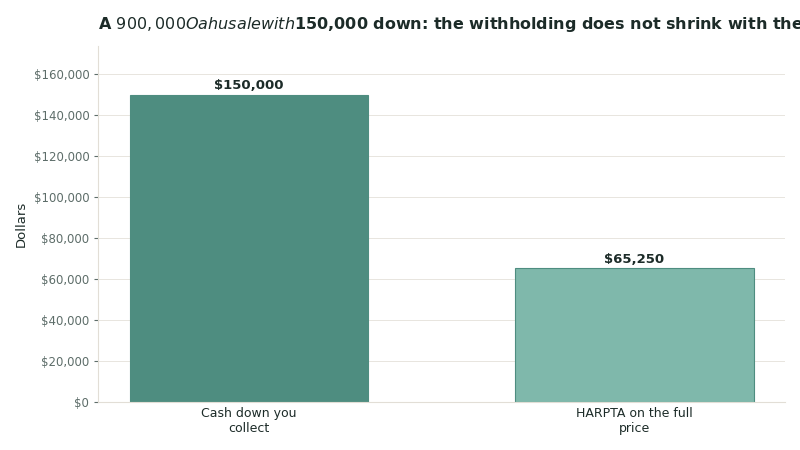
Those two bars are an illustration of the mechanism on a round $900,000 price, not a projection for your sale. Conveyance tax sits on top: HRS 247-2 puts a sale from $600,000 to under $1,000,000 at $0.20 per $100 of consideration, or $0.25 per $100 where the buyer is ineligible for a county homeowner exemption, so $1,800 or $2,250 on that price. Run your own numbers with your own payoff, your own commission, and your own basis.
Form N-288B Is the Only Lever, and It Has a Deadline
HRS 235-68(e) lets you apply to the Department for a withholding certificate on one of two showings: that you will realize no gain on the transfer, or that the proceeds will be insufficient to cover the withholding. If the Department agrees, it issues a certificate stating the amount to be withheld, if any.
That second ground is the seller financing ground. Form N-288B line 5b asks for sale proceeds received in forms other than cash, and the instructions give an agreement of sale or a purchase money mortgage as the example. The state built the form to handle exactly the sale you are describing.
The deadline is unforgiving. Form N-288B must be filed no later than 10 working days before the transfer date. Later filings are not accepted and are returned to the seller, and the instructions say in capital letters not to file it if the transfer has already taken place. The Department also will not approve it once the transfer date on the form has passed.
Ten working days is two full weeks on a calendar with no holidays. Back it up from your target closing date on the day you go under contract, not the week before. I walk through the filing itself in what Form N-288B does before closing, and the broader mechanics in how HARPTA withholding works for out of state Oahu sellers.
A caution on the structure itself. The Department’s published installment guidance addresses agreements of sale by name. A sale where title passes and you take back a note is a different instrument, and which one your contract actually creates decides whether withholding follows your payments or lands in one piece at closing. Have your CPA and a Hawaii attorney confirm which instrument you are signing before you price the deal.
Two things stay true either way. A certificate does not excuse you from filing a Hawaii income tax return for the year of sale. And gain is not equity: the Department states plainly that you can have a taxable gain with no equity in the property.
Frequently Asked Questions
Is HARPTA withheld on the interest my buyer pays me?
No. Tax Facts 2010-1 says the withholding requirement applies only to amounts attributed to principal and does not apply to any interest amounts. That makes the amortization schedule a tax document, so keep the principal and interest split clean from the first payment.
Can I file Form N-288B after closing and get the money back faster?
No. The form is due at least 10 working days before the transfer date, and the instructions say not to file it if the transfer has already happened. After closing you are in refund territory instead, which I cover in when you actually get HARPTA money back.
I live in Hawaii. Does HARPTA apply to my seller financed sale?
Tax Facts 2010-1 is clear that HARPTA applies even when the seller is a Hawaii resident, unless the seller gives the buyer a valid Form N-289. A buyer who fails to withhold is liable for the amount even if the buyer knows you are a resident, so expect escrow to collect that form.
My loan balance is higher than the price. Is there nothing to withhold?
Those are two separate questions. The Department states that you could have a taxable gain even with no equity in the property, and that if proceeds are insufficient to pay the withholding in full you may file Form N-288B for a certificate that reduces or eliminates the amount withheld.
Who sends the money to the state, me or the buyer?
The buyer. HRS 235-68 makes the transferee the withholding agent, liable for the amount that should have been withheld, and requires a return of the withheld amount filed with the Department no more than 20 days after the transfer date on Forms N-288 and N-288A.
More resources on this topic
HARPTA and a Short Sale on Oahu: What Happens to the Withholding When There Is No Equity. HARPTA still applies to an Oahu short sale, but a real exception exists when proceeds can't cover costs and.
HARPTA on Inherited Oahu Property: The Withholding Trap Most Heirs Hit. Selling an inherited Oahu home? Hawaii can withhold 7.25% of the sale price under HARPTA even when there is.
What Is a Short Sale on Oahu, and Why Do They Take So Long?. A short sale takes about 120 days total: roughly 90 for the lender's approval, then 30 to close, versus 30-45.
Hawaii GET on Your Oahu Rental: What Mainland Owners Owe. GET runs 4.5% of gross Oahu rent, and a short term rental adds 11% TAT plus 3% OTAT. Here is the license you.
Carrying the financing changes your cash flow, not the 7.25 percent, and the only tool that moves the number has a 10 working day fuse on it. I price seller carry structures for mainland owners before they go under contract, so you see the withholding, the conveyance tax, and the filing calendar side by side instead of finding them at signing. My guide for mainland Oahu sellers lays out the whole sequence. Get it at islandlivingoahu.com/guide-mainland.