

Quick Answer
What happens to my tenant’s security deposit when I sell my Oahu rental from the mainland?
It transfers with the property, not with you. Hawaii’s Residential Landlord-Tenant Code binds the next owner, so you account for the deposit and hand it to the buyer at closing. The buyer then has 20 days to tell your tenant in writing what deposit amount is credited to them. Skip that handoff and the tenant is presumed to have paid a full month’s rent, whatever your records say.
By Aksana Tupalskaya | November 12, 2026
The security deposit is the smallest number on your closing statement and the one that generates the angriest phone call six months later. I have watched a $2,400 deposit turn into a small claims filing because nobody wrote down who was holding it.
Here is the part mainland owners miss. The deposit is not a sale cost and it is not yours to pocket at closing. It is your tenant’s money that you are holding, and Hawaii law follows the unit, not the owner.
The Deposit Follows the Unit, Not the Owner
Hawaii Revised Statutes chapter 521 caps a residential security deposit at one month’s rent. A landlord may add a separate pet deposit, also capped at one month’s rent, and that pet deposit cannot be charged to a tenant with no pet or to a tenant whose assistance animal is an approved disability accommodation.
When you transfer your interest by sale, HRS 521-44 makes the successor bound by the same deposit rules that bound you. The statute puts the accounting in your hands: you give the buyer a statement of every deposit you hold, at or before the transfer.
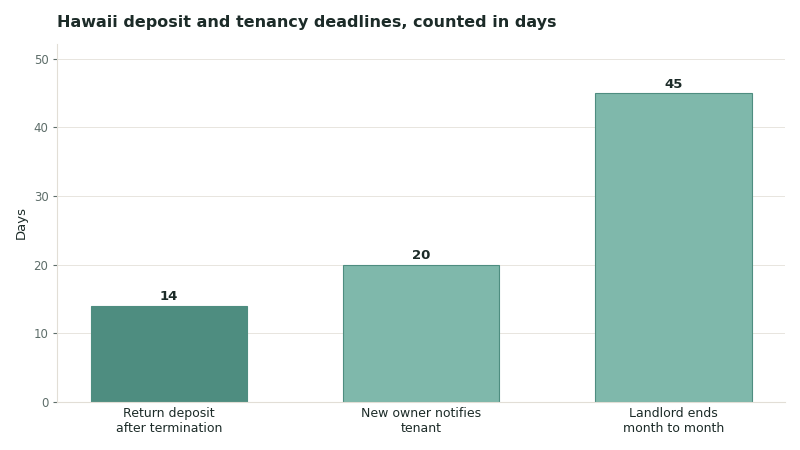
Then the clock moves to the buyer. Within 20 days of the transfer, the new landlord has to give each tenant written notice of the deposit amount credited to that tenant.
If that notice never goes out, the statute fills in the blank against the new owner. The tenant is assumed to have paid a deposit of no less than one month’s rent at the rate originally charged. On an Oahu single family rental at $4,200 a month, that is a $4,200 assumption even when the actual deposit was $2,000.
HRS 521-43 adds a second piece people forget. The tenant has to have the name and address of the owner or the owner’s authorized agent in writing, and it has to be kept current at all times. A sale changes that information, so somebody has to update it.
| What has to happen | Whose job it is | The deadline |
|---|---|---|
| A written accounting of every deposit you hold | You, the seller | At or before the transfer |
| The deposit money or a settlement credit for it | You, through escrow | At closing |
| Written notice to the tenant of the deposit amount credited | The buyer, as the new landlord | Within 20 days of the transfer |
| Current owner or agent name and address, in writing | The buyer, as the new landlord | Kept current at all times |
| Return the deposit or itemize what is kept, with evidence | Whoever is landlord when the tenancy ends | Within 14 days of termination |
| Nothing, because the 20 day notice was skipped | The buyer inherits the result | Deposit presumed to be one full month’s rent |
What this tells me as the numbers agent for Oahu sellers: every deadline on that list belongs to somebody other than you the moment escrow closes, which is exactly why the written accounting is the only protection you actually keep.
Where This Goes Wrong on a Remote Sale
Three failure patterns, and I have seen all three on Oahu.
The deposit was already spent. An owner four time zones away used it to cover a plumbing repair two years ago and never replaced it. At closing there is nothing to transfer, and the obligation still exists.
A property manager has it and nobody asks. If a management company holds the deposit in a trust account, the transfer has to be coordinated with that company in writing before escrow closes, not after the keys change hands.
Nobody tells the tenant. The money moves correctly, the 20 day notice never goes out, and the deposit defaults upward to a full month’s rent by operation of law.
In Hawaii your closing runs through escrow rather than an attorney, and escrow will handle the deposit the way your purchase contract tells it to. The usual mechanic is a credit to the buyer on the settlement statement for the deposit amount, with the buyer taking over the obligation. That only works if the contract says so and the number is right.
This is a legal question sitting inside a real estate transaction, so confirm your own facts with a Hawaii attorney and your CPA before you sign anything. I will tell you what I see on the ground. They will tell you what applies to your paperwork, and you should run your own numbers rather than assuming the deposit is a wash at closing.
The 14 Day Rule That Outlives Your Sale
Whoever is the landlord when the rental agreement ends has 14 days after termination to return the remaining deposit. If any of it is being kept, the tenant also gets written notice with the particulars and grounds for the retention, plus written evidence of the costs, things like estimates, invoices, receipts, or cleaning charges.
Miss the 14 days and the entire deposit goes back. Not the disputed part. All of it.
Deposit disputes in Hawaii go to small claims court, where neither side may be represented by an attorney. If the court finds the retention was wrongful and willful, it may award the tenant damages equal to three times the deposit, or three times the part wrongfully retained, plus the cost of the suit. The tenant has one year after termination to file.
If your tenant is staying through the sale, the deposit is only one of the items that has to travel with the unit. I walk through the rest of that handoff in my post on selling an Oahu rental with a tenant in place from the mainland, and the remote signing logistics in my post on signing an Oahu home sale from the mainland.
One more timing note, because it comes up every single time. Ending a month to month tenancy takes 45 days of written notice from the landlord and 28 days from the tenant, and 120 days if the unit is being converted to a transient vacation rental. Those are different clocks from the deposit clocks, and owners mix them up constantly.
Frequently Asked Questions
Can I just give the security deposit back to my tenant before closing?
You can hand the money back, but the tenancy continues after the sale unless it has been properly terminated, and the deposit rules still bind the new owner. Returning it mid tenancy without ending the rental agreement usually creates more confusion than it solves. Decide it with your attorney and put the outcome in the purchase contract.
Does the buyer have to honor my tenant’s existing lease?
Yes. After a sale during the term, the new owner and the tenant are both bound by the terms of the rental agreement. A buyer who wants the unit vacant has to deal with the existing tenancy, which makes it a negotiation point before you go under contract rather than a surprise after.
What if I never collected a deposit at all?
Then there is nothing to transfer, and you say exactly that in writing in the accounting you give the buyer. The one month presumption bites when the new owner fails to give the 20 day notice, so a buyer who documents a zero deposit from day one is in a far better position than one who stays quiet.
Who is responsible if the tenant sues over the deposit after I sell?
The successor is bound by the deposit rules once the transfer happens, which is why the accounting and the 20 day notice carry so much weight. A clean paper trail from you to the buyer is the thing that keeps you out of it. Keep copies of all of it for at least a year after the tenancy ends.
Is the deposit part of my sale proceeds for tax purposes?
The deposit is your tenant’s money, not sale proceeds, so it is not part of your gain on the property. HARPTA withholding and conveyance tax are calculated on the sale itself and handled by escrow, separately from the deposit transfer. Your CPA should confirm how all of it lands on your return.
More resources on this topic
Selling an Oahu Rental With a Tenant in Place, From the Mainland. Selling an Oahu rental with a tenant in place, from out of state? The real numbers: 45 days notice, two days.
Hawaii GET on Your Oahu Rental: What Mainland Owners Owe. GET runs 4.5% of gross Oahu rent, and a short term rental adds 11% TAT plus 3% OTAT. Here is the license you.
You Inherited a House on Oahu and Live on the Mainland: What Happens First. Inherited a home on Oahu from the mainland? Here is the order of operations: legal authority, insurance, and a.
Should You Sell or Rent Your Oahu Home After a PCS Move?. PCS orders force a decision on your Oahu home fast. Here's how to weigh selling against becoming an.
A security deposit is a 20 day paperwork problem that turns into a three times damages problem when nobody owns it. I built a guide for mainland owners that walks through the whole remote sale, the deposit handoff, the HARPTA forms, and the documents escrow will ask you for, so you are not learning any of this at 2 a.m. in another time zone. Get it at islandlivingoahu.com/guide-mainland.