

Quick Answer
What happens if I miss the August 20 or February 20 Oahu property tax deadline?
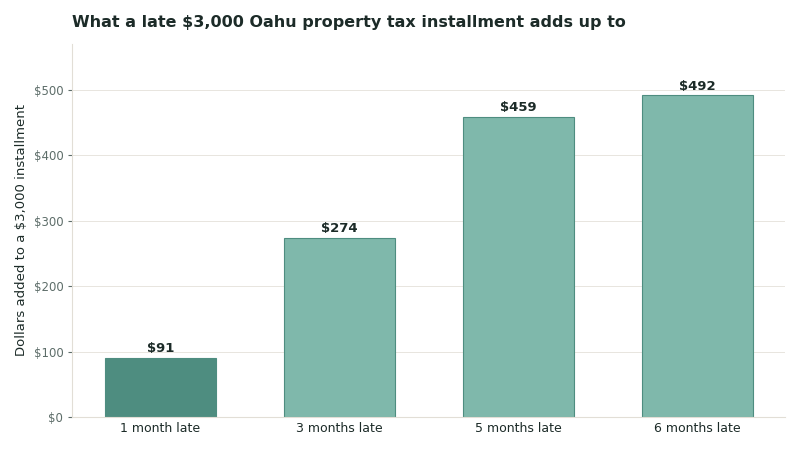
The City and County of Honolulu adds a 2% penalty for each month or fraction of a month you are late, capped at 10% of the taxes levied, plus 1% a month in interest on the tax and the penalty. On a $3,000 installment, one month late runs about $91 and six months late runs about $492. The penalty starts the day after the due date, not the day you open the envelope.
By Aksana Tupalskaya | November 12, 2026
Honolulu bills your real property tax in two halves, and the first half is the one owners miss. Not because the amount shocks them. Because the envelope went to an address they no longer check.
The first installment bill mails July 20 and is due August 20. The second mails January 20 and is due February 20. Those dates do not move for your closing, your move, or your mainland bank’s processing time.
Two Dates, and the Address Problem Behind Them
If a due date lands on a weekend or a holiday, it rolls to the next business day. For a mailed payment, the post office cancellation mark sets the effective date, so the postmark is what the city reads, not the day the check arrives downtown.
Everything unpaid after the due date is delinquent. There is no grace window built into the ordinance.
Now the part that explains why mainland owners and brand new owners miss August 20 specifically. The Real Property Assessment Division assesses as of October 1, and if a property sold after October 1, the new owner will not receive that year’s Notice of Assessment at all. The tax bill goes to the address of record, and the address of record is whatever the city holds, not whatever is on your deed.
Changing the mailing address for a tax bill cannot be done online. RPAD wants a written request with the parcel ID or tax map key, the site address, the new mailing address, a phone number, and the reason for the change, submitted by mail or in person. For a mailing address change, RPAD points owners to its Change of Status form.
One more trap. Escrow often prorates property tax between buyer and seller at closing, and that proration is a settlement between the two of you. It is not a payment to the city, and it does not change whose mailbox the next bill lands in.
| How late the installment is | Penalty added, at 2% a month | Interest added, at 1% a month |
|---|---|---|
| One month, or any part of one | $60 | About $31 |
| Two months | $120 | About $62 |
| Three months | $180 | About $94 |
| Five months, where the penalty caps out | $300 | About $159 |
| Six months | $300, with no further penalty | About $192 |
What this tells me as the numbers agent for Oahu owners: the penalty clock cannot tell the difference between three days late and three weeks late, so the cheapest possible version of this problem is a reminder on your calendar for August 10.
What Late Actually Costs
The mechanics live in the Revised Ordinances of Honolulu, section 8-3.3. The penalty is 2% of the delinquent tax for each month or fraction of a month, starting the first calendar day after the due date, and the total penalty may not exceed 10% of the taxes levied. It applies to the delinquent tax itself, not to penalties that already accrued.
Interest is separate and runs 1% for each month or fraction of a month on the delinquent taxes and the penalties, until paid. Both the penalty and the interest become part of the tax and get collected with it.
Read the phrase fraction of a month twice, because that is where the money is. Three days late and twenty nine days late both cost you the same 2%.
On a $3,000 installment, that works out to roughly $91 added at one month, $274 at three months, $459 at five months where the penalty tops out, and $492 at six months. Those figures follow the stated rates. The city computes the exact number on your parcel, so run your own numbers off your own bill rather than mine.
Filing an assessment appeal does not pause any of this. The ordinance says an appeal does not exempt a taxpayer from the delinquency penalty, and tax paid under a properly filed appeal is held in a trust account. Pay on time and argue the value separately, which is a January conversation I lay out in my post on the January 15 Oahu assessment appeal deadline.
Your CPA can tell you how the tax, the penalty, and the interest land on your own return. That is a question for them, not for me.
Make Sure the Bill Reaches You
This post ends on one decision, and it is not about money. It is about who receives the bill, in writing, at an address you will still be checking in July.
Here is the short list I give every out of state owner and every new buyer.
One. File the written mailing address change with RPAD yourself. Do not assume the deed recording, your escrow officer, or the prior owner moved it for you.
Two. Pull up your own parcel record and read back the mailing address the city actually holds. Most people have never looked.
Three. Set two calendar reminders, August 10 and February 10, ten days ahead of each deadline. If you pay from a mainland bank by mail, make it fifteen.
Four. If a lender escrows your taxes, confirm the city shows them paid after each installment. A tax escrow that quietly lapsed after a refinance is the second most common way I see this go sideways.
Five. If you bought this year, handle the home exemption in the same sitting, because the exemption is what sets the amount on those two bills in the first place. I cover the filing in my post on refiling the home exemption after buying on Oahu and the first year wrinkle in my post on the grandfathered exemption a new Oahu buyer inherits.
Frequently Asked Questions
I never got a bill. Do I still owe the penalty?
The ordinance ties the penalty to the due date, not to the day the bill reached you. Anything unpaid after the due date is delinquent regardless. If a bill has not shown up by late July or late January, call the Treasury Division instead of waiting for it.
I just bought on Oahu. Will the bill come to me automatically?
Not necessarily for your first cycle. Assessment is as of October 1, and a buyer who closed after that date will not receive that year’s Notice of Assessment. Confirm in writing what mailing address the city holds for your parcel rather than finding out in August.
Does the postmark count, or does the city have to receive it by the 20th?
For a mailed payment, the post office cancellation mark sets the effective date. Mailing from the mainland means getting the envelope into the mail stream early enough to be postmarked on or before the due date, which is not the same as dropping it in a box on the 19th.
Can I pay the whole year at once in August?
Paying ahead of a due date is never penalized. What gets penalized is a balance left unpaid after one. If you want to send a single payment for the year, confirm with the Treasury Division that your parcel’s second installment can be paid early before you write the check.
Does filing an appeal pause the deadline?
No. An appeal does not exempt you from the delinquency penalty, and tax paid under a properly filed appeal goes into a trust account until the appeal resolves. Pay the bill on time and fight the assessment on its own track.
More resources on this topic
Short-Term Rentals and Oahu Property Tax: What the Transient Vacation Class Actually Costs. A legal short-term rental on Oahu can fall into the Transient Vacation property tax class, which costs far more.
The Totally Disabled Veteran Property Tax Exemption on Oahu: What It's Worth and Who Qualifies. A 100% disabled veteran's Oahu property tax bill can drop to the city's $300 minimum. Here is who qualifies and.
Just Bought an Oahu Home? The Property Tax Exemption You Saw Was the Seller's, Not Yours. The property tax figure you saw when you bought your Oahu home was the seller's exemption. You're grandfathered.
Moving a Parent Into Care on Oahu? Here's What Happens to Their Property Tax Exemption. If your parent is moving into a licensed Oahu care facility, their home exemption can usually stay in place.
Both of your Oahu deadlines come down to whether the bill reaches you, and that is one written request to RPAD rather than a hope. Every month I pull the Oahu numbers owners actually need, what homes closed at after seller credits, how the assessment and exemption math is landing, and which deadlines are next, into a report I send out free. Get it at islandlivingoahu.com/reports.