
Quick Answer
What is the disabled veteran property tax exemption on Oahu worth?
For a veteran rated 100 percent totally disabled from a service-connected injury, it reduces the real property tax bill to the city’s $300 minimum, a full exemption from the ordinary bill, and it extends to an unmarried surviving spouse who continues to own and live in the home.
By Aksana Tupalskaya | November 12, 2026
Most Oahu homeowners know about the standard home exemption and its September 30 deadline. Far fewer know there is a separate, far more valuable exemption for a specific group of owners, one that does not just reduce the tax bill, it collapses it down to the city’s $300 minimum.
Who Actually Qualifies
The Totally Disabled Veteran’s Exemption, under the City and County of Honolulu’s own ordinance, is available to a veteran rated 100 percent totally disabled from an injury sustained while on active duty with the U.S. Armed Forces. It also extends to an unmarried widow or widower of a qualifying veteran, as long as they continue to own and live in the home. This is specifically a 100 percent rating. It is not the same program as a partial disability rating, and the standard home exemption everyone else files is still the right one for a veteran rated below 100 percent.
What It’s Actually Worth
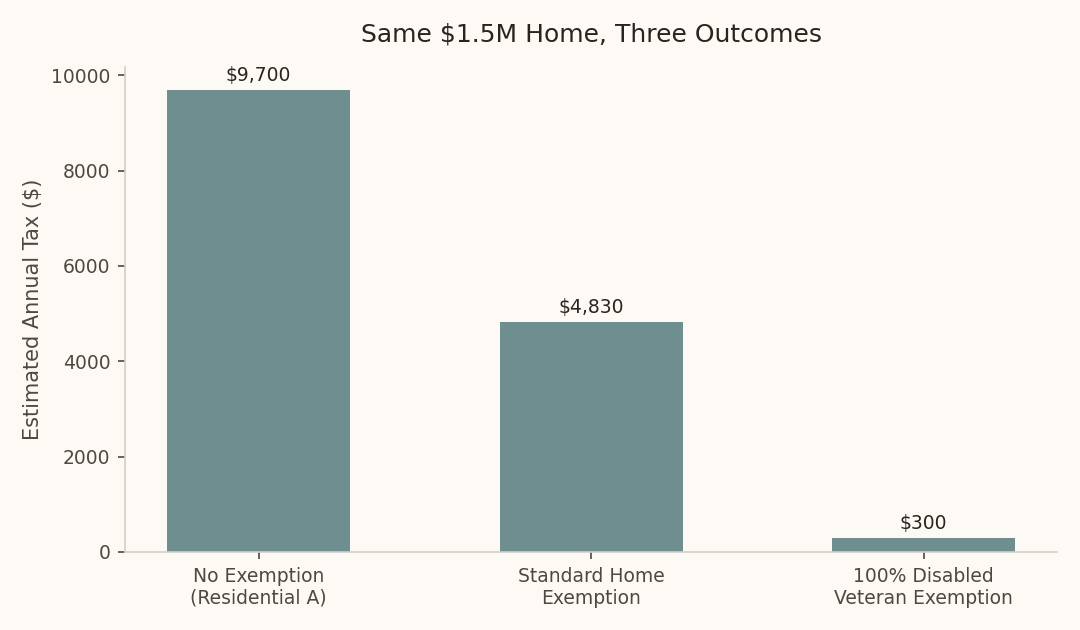
The standard home exemption reduces your taxable value by a set amount, $120,000 under 65 or $160,000 at 65 and older, but you still owe tax on everything above that. The totally disabled veteran exemption works differently. It is a full exemption from the ordinary real property tax, subject only to the city’s minimum real property tax, currently $300 a year. On a $1,500,000 home, a qualifying veteran’s bill drops from what would otherwise be roughly $4,830 with the standard exemption, or roughly $9,700 with no exemption in the Residential A class, down to $300. The higher the home’s value, the larger the gap this exemption closes.
How It’s Different From the Home Exemption Everyone Else Files
The standard home exemption has a hard, well known deadline: file by September 30 for it to apply to the tax year starting the following July. The totally disabled veteran exemption does not appear to run on that same calendar. The guidance ties it instead to the semi-annual tax payment cycle, starting with whichever upcoming payment date follows your filing. Because the exact cutoff tied to each payment date can shift and because this is a benefit worth getting right the first time, confirm the current filing cutoff directly with the Real Property Assessment Division before you file, rather than assuming the September 30 date that governs the standard exemption applies here too.
How to File
The claim is filed on Form BFS-RP-E-10.5, Claim for Exemption Totally Disabled Veteran, through the Real Property Assessment Division. Supporting documentation of the 100 percent disability rating from the VA will be part of what the division asks for. If you are an unmarried surviving spouse applying under the same exemption, be ready to show that you continue to own and occupy the home as your principal residence.
This exemption is separate from, and should not be confused with, VA loan benefits like the funding fee. This earlier piece on the VA funding fee refund many veterans never claim covers that different program in detail.
| Exemption | Who Qualifies | What It Reduces Your Bill To |
|---|---|---|
| Standard home exemption | Any owner-occupant, filed by September 30 | Assessed value minus $120,000 (under 65) or $160,000 (65+), still taxed on the rest |
| Totally disabled veteran exemption | A veteran rated 100% totally disabled, or their unmarried surviving spouse | The city’s minimum real property tax, currently $300 a year |
What this tells me as the numbers agent for Oahu sellers: this exemption is worth checking for directly rather than assuming the standard home exemption is the only one on the table, because the gap it closes grows with the home’s value.
Frequently Asked Questions
Does a 70 or 90 percent VA disability rating qualify for this exemption?
This specific exemption is written around a 100 percent total disability rating. A lower rating does not appear to qualify for this program, though the standard home exemption is still available. Confirm the current eligibility rules directly with the Real Property Assessment Division, since program details can be updated.
Can I claim this exemption and the standard home exemption at the same time?
There is no need to. The totally disabled veteran exemption already reduces the bill to the $300 minimum, which is more favorable than the standard exemption on its own.
What happens to the exemption if the surviving spouse remarries or moves?
The exemption is tied to the surviving spouse continuing to own and occupy the home. Confirm the specific rules around remarriage or a change in residence with the Real Property Assessment Division.
Is this the same thing as the VA funding fee waiver on a home loan?
No. The funding fee waiver is a loan-origination benefit tied to VA financing. The totally disabled veteran exemption is a separate, ongoing property tax benefit administered by the city.
If you are not sure whether your own home exemption, or this one, is actually on file and current, I put together a short guide on how to check and how to file. Get it at islandlivingoahu.com/reports.