
Quick Answer
What is your basis when you sell an Oahu home you inherited?
IRS Publication 551 says your basis in inherited property is generally its fair market value on the date the owner died, or on the alternate valuation date if the personal representative elects it, not what the owner originally paid decades ago. One exception: if the heir or the heir’s spouse gave appreciated property to the owner within one year before the death, the heir’s basis is the owner’s adjusted basis immediately before the death. Publication 551 says basis is what you use to figure gain or loss on a sale.
By Aksana Tupalskaya
The Rule That Changes Everything: Stepped-Up Basis
When you inherit an Oahu home, your basis generally is not what the original owner paid for it in 1975 or 1995. IRS Publication 551 says the basis of property inherited from a decedent is generally its fair market value on the date of death, or on the alternate valuation date if the personal representative elects alternate valuation. The underlying law is Internal Revenue Code section 1014. That number, not the decades-old purchase price sitting in an old escrow file, is the starting point for figuring your gain.
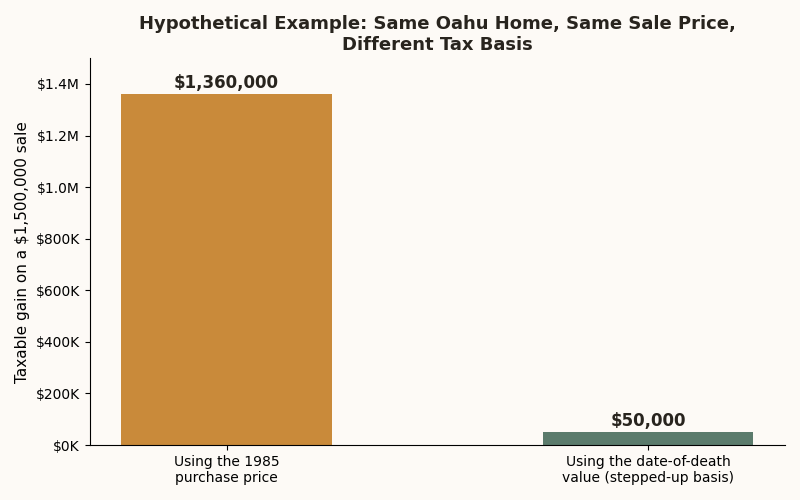
Here is a hypothetical to make it concrete. Say the owner bought a Kailua home in 1985 for $140,000 and died in early 2026, and an appraisal placed the home’s fair market value at $1,450,000 on the date of death. Your basis is generally $1,450,000. If you sell the home eighteen months later for $1,500,000, the gain in this example is $50,000, not the $1,360,000 it would be if the original purchase price still applied.
What Records the Date of Death Value
If the estate goes through probate in Hawaii, the personal representative must prepare and file or mail an inventory within three months after appointment, listing each item of the decedent’s property at its fair market value as of the date of death, with any encumbrance, and send a copy to interested persons who ask for it. A special administrator, and a successor to a representative who already did this, are not required to.
The simplest way to protect this number is to have the home appraised as of the date of death, before it goes on the market.
Where This Runs Into HARPTA
The stepped-up basis does not switch off HARPTA. Unless an exception applies, the buyer must withhold 7.25 percent of the amount realized, which is generally the sale price, when the seller is a nonresident person. The amount withheld is not a separate tax: it is an estimated payment credited against your Hawaii income tax, and any overpayment is refunded. Form N-288B is used only for a claim that you will realize no gain or that the proceeds will be insufficient to pay the withholding, and it must be filed no later than 10 working days before the transfer date. On its no-gain worksheet, if the sales price minus your adjusted basis is greater than zero, you do not qualify for a waiver, unless the property was your main home and you qualify to exclude the entire gain, in which case Form N-103 is used as a worksheet and attached to Form N-288B.
| Scenario | Basis Used | Hypothetical Sale Price | Gain in This Example |
|---|---|---|---|
| No step-up (original 1985 purchase price) | $140,000 | $1,500,000 | $1,360,000 |
| With step-up (date-of-death value) | $1,450,000 | $1,500,000 | $50,000 |
Two Mistakes Heirs Make
Mistake one: using the old purchase price out of habit. The original closing statement may be the easiest paperwork to find, but for inherited property the basis is generally the date of death value. Using the old price can mean paying tax on appreciation that happened before you ever owned the property.
Mistake two: never getting a date of death appraisal at all. If you wait years to sell with no record of what the home was worth when you inherited it, you are left reconstructing a historical value after the fact.
Frequently Asked Questions
Does the stepped-up basis reduce HARPTA withholding automatically at closing?
No. Unless an exception applies, the buyer withholds 7.25 percent of the amount realized, which is generally the sale price. Form N-288B is used only for a claim of no gain or of insufficient proceeds to pay the withholding, and it must be filed no later than 10 working days before the transfer date. On its no-gain worksheet, if the sales price minus your adjusted basis is greater than zero, you do not qualify for a waiver, unless the property was your main home and you qualify to exclude the entire gain.
Does this mean I owe no tax at all if I sell quickly?
Not necessarily. Your basis is generally the date of death value, and Publication 551 says basis is used to figure gain or loss on a sale, so a sale price above that basis can produce a gain.
If You Are Sorting This Out From the Mainland
If you are deciding about an Oahu property from the mainland, the tax math above is one piece of a bigger picture that can include probate, HARPTA, and whether to sell as is or prepare the home first. The right first step is usually a conversation, not a spreadsheet.
If you are working through an inherited Oahu property and want to talk through what the sale actually looks like for your situation, you can book a free strategy call at islandlivingoahu.com/strategy. You can also read more about what happens to a mortgage you inherit along with the house if that is part of your situation too.
Aksana Tupalskaya REALTOR® (S) RS-85710 | Island Living Oahu of Keller Williams Honolulu RB-21303