

Quick Answer
What does the notice the City and County of Honolulu mails every December actually show?
It’s a notice, not a bill. It lists your property’s new assessed value based on sales through the prior June, your tax classification, any exemption on file, and the net taxable value that next year’s rate applies to. It’s also your one window to appeal the assessed value before January 15.
By Aksana Tupalskaya | November 11, 2026
Every December, the City and County of Honolulu’s Real Property Assessment Division mails a notice to every property owner on Oahu. It is not a bill, and that distinction trips people up every year. It is the number that next year’s bill will be calculated from, and it is also the only window you get to challenge that number before it becomes final.
Six Lines, Six Jobs
The notice carries a short list of fields, and each one does a different job. Your property ID, the tax map key, identifies the parcel. The assessed value is the division’s estimate of fair market value, based on comparable sales through the prior June, not on anything that happened after that cutoff. Your tax classification determines which rate schedule applies to you, whether that is standard Residential, Residential A, or another class. The exemption amount shows whatever is on file for you, most commonly the owner-occupant home exemption. A special assessment line appears only if one applies to your property specifically. And the net taxable value, the number everything else exists to produce, is the assessed value minus your exemption, and it is what the tax rate actually gets applied to.
The Number That Actually Decides Your Bill
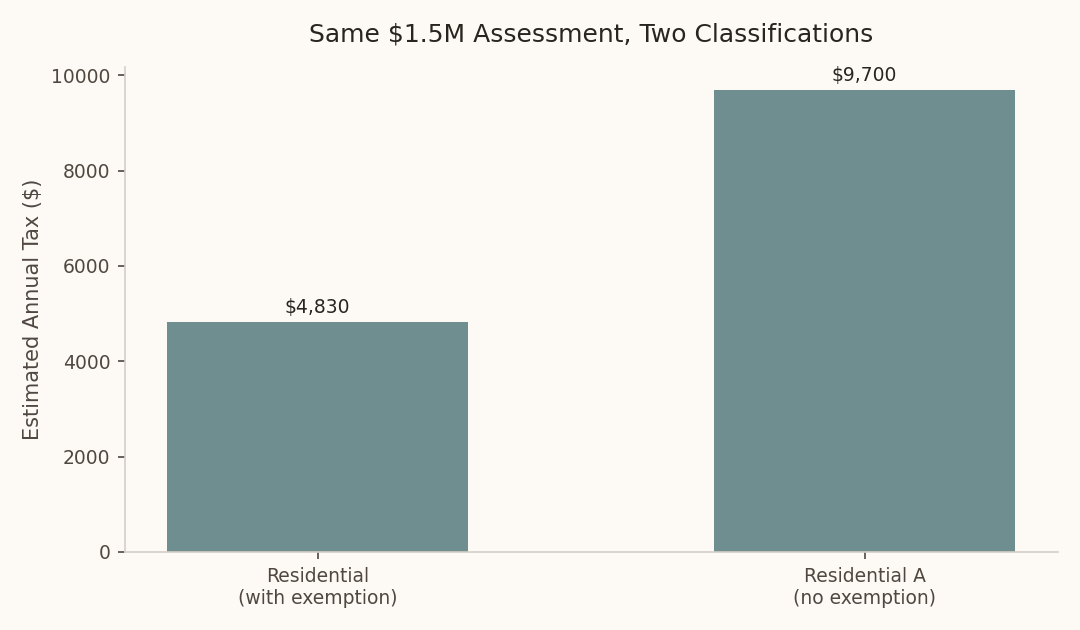
Net taxable value is the line to read closely, because the rate that applies to it depends entirely on your classification, and that gap is larger than most owners expect. Take a property assessed at $1,500,000. If the owner-occupant exemption is on file and the home stays in the standard Residential class, the tax works out to roughly $4,830 a year. The same $1,500,000 property with no exemption filed, sitting in the Residential A class instead, works out to roughly $9,700 a year, more than double, on the exact same assessed value. The classification line is doing more work than the assessed value line, and it is the one owners are most likely to skim past.
When the Notice Is Wrong, and What the 10 Percent Rule Actually Means
You can appeal the assessed value, but only on a specific basis: you have to show it is more than 10 percent above actual market value, with evidence to support that claim. The appeal window runs from the December mailing through January 15, and it requires a $50 deposit regardless of how the appeal turns out. The mechanics of filing, the deadlines by submission method, and what counts as acceptable evidence are covered in full in this earlier piece on the January 15 appeal window, so this one stays focused on reading the notice itself rather than repeating the filing steps.
What to Do Before You Decide to Appeal
Before you decide whether an appeal is worth your time, check three things on the notice itself. First, confirm your exemption line actually reflects what you filed, especially if you filed by the September 30 deadline this year and the increase to the exemption amount has not shown up yet. Second, confirm your classification line matches what you expect, since a Residential A classification sitting where you thought the home exemption applied is the single costliest mismatch on the whole notice. Third, before assuming the assessed value itself is wrong, look at what actually sold near you recently, since that comparison is the real evidence an appeal would need anyway.
| Line on the Notice | What It Means | What to Check |
|---|---|---|
| Assessed value | Fair market value estimate from comparable sales through the prior June | Does it roughly match what similar homes near you have sold for recently |
| Tax classification | Which rate schedule applies: Residential, Residential A, or another class | Does it match what you expect, especially if you recently filed or should have filed an exemption |
| Exemption amount | Deduction from assessed value, most often the owner-occupant home exemption | If you filed by September 30, is it actually reflected here |
| Net taxable value | Assessed value minus exemption; the number the tax rate is applied to | This is the figure that actually determines your bill, not the assessed value alone |
What this tells me as the numbers agent for Oahu sellers: two identically assessed homes can owe wildly different tax bills, and the classification and exemption lines, not the assessed value, are usually why.
Frequently Asked Questions
Is the December notice the same thing as my property tax bill?
No. The notice tells you next year’s assessed value and classification. The actual bill arrives separately, with payments generally due around August 20 and February 20.
What if my exemption line is blank even though I filed by September 30?
Contact the Real Property Assessment Division directly to confirm your filing was processed before relying on what the notice shows, rather than assuming it will correct itself later.
Can my assessed value go up even if I haven’t changed anything about my home?
Yes. The assessed value reflects comparable sales across your area through the prior June, not changes to your specific property, so a strong local market can raise your number with nothing done to the home itself.
Does appealing cost anything if the appeal doesn’t succeed?
Yes, a $50 deposit is required to file an appeal regardless of the outcome.
The fastest way to check whether your new assessed value is in the right range is to see what has actually sold near you lately, not just the number on the notice. Get the free monthly sold report, with the seller credits most portals never show, at islandlivingoahu.com/credits.