
Quick Answer
How much time do you actually have to complete a 1031 exchange after selling an Oahu property from out of state?
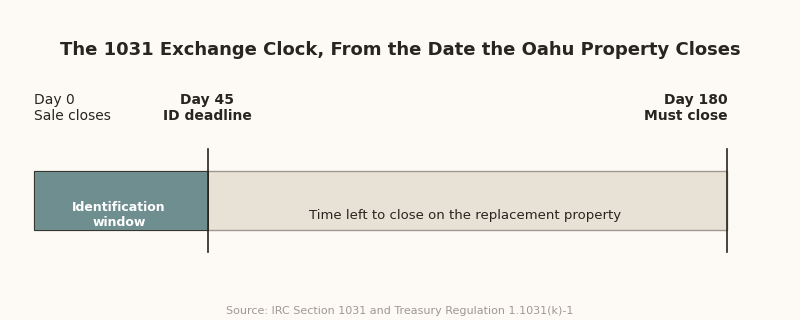
The clock starts the day your Oahu sale closes, not the day you decide to do an exchange. You have 45 calendar days from that closing to formally identify replacement property in writing to your qualified intermediary, and 180 calendar days total, or the due date of your tax return for that year if earlier, to close on the replacement. Both deadlines run on calendar days, including weekends and holidays, and living on the mainland does not extend either one.
By Aksana Tupalskaya | November 4, 2026
Why the Distance Makes This Harder, Not the Rule Itself
The 1031 exchange rules themselves are federal and identical no matter where the seller lives. What changes when you are selling an Oahu property from the mainland is not the deadline, it is the logistics running against that deadline: viewing replacement property, coordinating closings, and routing paperwork, all while a short, fixed clock is already running.
I cover the broader decision of whether a 1031 exchange makes sense for your situation at all in 1031 exchange or sell outright, and whether your replacement property even has to be in Hawaii in can your 1031 replacement property be outside Hawaii. This post assumes you have already decided to exchange, and focuses only on the clock.
The 45-Day Identification Window
From the day your Oahu property closes, you have 45 calendar days to identify replacement property in writing, signed, and delivered to your qualified intermediary or another party to the exchange specified under the regulations. A verbal mention to your agent does not count, and neither does a property you are merely considering. You generally have two ways to satisfy the identification rule:
- The three-property rule: identify up to three properties, regardless of their combined value, and you can later close on any one or more of them.
- The 200 percent rule: identify more than three properties, as long as their combined fair market value does not exceed 200 percent of what you sold.
The single most common mistake I see from out-of-state sellers is treating the qualified intermediary as something to set up after closing, once there is time to think. The intermediary has to be in place before your Oahu property closes, holding the proceeds so you never take constructive receipt of the money. If you close first and call a qualified intermediary afterward, the exchange is already dead, regardless of how many days remain on the clock.
Naming a Fallback Inside the Three-Property Rule
There is a practical move inside that first rule that most mainland sellers have never heard of, and it is worth knowing before day 45 arrives rather than after. You do not have to spend all three identification slots on properties you are actively trying to buy. One of them can be a fallback, named only so the exchange has somewhere to land if your first choice falls out of escrow or an inspection goes badly.
The fallback most often used for that is a Delaware Statutory Trust, usually just called a DST. A DST is a trust that already owns real estate, and what you acquire is a beneficial interest in the trust rather than a building of your own. The IRS addressed this directly: Revenue Ruling 2004-86 holds that a taxpayer may exchange real property for an interest in such a trust without recognition of gain or loss under Section 1031, if the other requirements of Section 1031 are satisfied. Because the trust has already bought and closed on its property, closing into a DST interest is closer to paperwork than to a purchase, which is why it can be completed inside a window that would never be long enough to find, inspect and close on a replacement building from three thousand miles away.
Two things to be clear about, because this gets oversold. Backup is not an IRS category. There is no special backup designation on an identification letter. It is simply a property you named inside the ordinary rules and would accept if the others fail, which means it uses up one of your three slots like anything else. And a DST interest is a security rather than a deed: it is sold through broker dealers, it is illiquid, you have no management control, and the trustee’s powers are deliberately restricted, which that same revenue ruling spells out at length. Whether one belongs on your identification letter is a conversation to have with your qualified intermediary and your CPA before day 45, not a decision to make on day 44.
The 180-Day Closing Deadline
You then have 180 calendar days from the same closing date, or the due date of your federal tax return for the year of the sale including extensions, whichever comes first, to actually close on the replacement property you identified. If your sale closes late in the year, this is worth watching closely: a tax return due date that falls before day 180 can shorten your real window, though filing an extension on that return pushes the tax deadline back out to the full 180 days.
Being on the mainland does not require you to be physically present for any of this. Closings, identification letters, and loan documents can all be signed and routed remotely. What distance actually costs you is reaction time: a property you cannot drive past on a Tuesday afternoon takes longer to evaluate seriously, which is exactly why lining up your search, your lender, and your qualified intermediary before your Oahu sale closes matters more than it would for a local seller.
What Happens If You Miss Either Deadline
There is no grace period built into either deadline, and no case-by-case flexibility from the IRS outside of specific, federally declared disaster relief that occasionally extends exchange deadlines in affected areas. Miss the 45-day identification window, or miss the 180-day closing deadline on a property you did identify, and the exchange simply fails. The sale is then treated as a fully taxable transaction, and any gain you were deferring becomes recognized in the year of the original sale.
The dollar stakes of missing the clock scale with the gain being deferred, not just the sale price. A seller who sold for far more than they paid years ago, after depreciation and appreciation on an Oahu property, can be deferring a substantial federal and state tax bill through the exchange. Missing either deadline does not just cost convenience, it converts that deferred gain into a current tax liability in the year of the original sale, due with that year’s return.
| Deadline | What It Requires | What Happens If You Miss It |
|---|---|---|
| Day 45: Identification | Written, signed identification delivered to your qualified intermediary, naming specific replacement property | Any property not identified in time cannot be used, and if nothing was validly identified the exchange fails entirely |
| Day 180: Closing | Closing on identified replacement property, or your tax return due date for the year of sale if that comes first | The exchange fails and the transaction is taxed as an outright sale |
| Engaging a qualified intermediary | Must be arranged before the Oahu property closes, not after | Closing without a QI already in place means you cannot set up a valid exchange retroactively |
What this tells me working with mainland sellers: the paperwork that actually protects an exchange has to be in place before your Oahu closing, not during the 45 days that follow it.
Frequently Asked Questions
Can I get an extension on the 45 or 180 day clock?
The 45-day identification window is not extendable under ordinary circumstances. The 180-day closing deadline can effectively move earlier if your tax return’s due date falls before day 180, but filing a tax extension on that return restores the full 180 days. Outside of specific, federally declared disaster relief, there is no general extension available.
Does the clock pause if I am traveling or hard to reach?
No. Both deadlines run on calendar days regardless of your location, availability, or whether you are actively working on the exchange that week.
Do I need to be physically on Oahu to meet these deadlines?
No. Identification letters, closing documents, and loan paperwork can all be signed and routed remotely. The distance mainly costs you reaction time for evaluating replacement properties, which is why preparation before your Oahu sale closes matters more than physical presence.
Can I name a backup replacement property in case my first choice falls through?
Yes, within the ordinary rules. The three-property rule lets you identify up to three properties regardless of value, and nothing requires all three to be properties you are actively pursuing, so one slot can be held for a fallback. A Delaware Statutory Trust interest is the fallback most often used, because the trust has already closed on its property and the IRS held in Revenue Ruling 2004-86 that an interest in such a trust can be received in a Section 1031 exchange without recognition of gain or loss. There is no formal backup designation on an identification letter; it is just a property you named and did not end up needing. Talk to your qualified intermediary and your CPA before you put one on the letter.
What exactly counts as “identifying” a replacement property?
A written, signed identification delivered to your qualified intermediary or another authorized party to the exchange, by the 45th day, following either the three-property rule or the 200 percent rule described above. An informal mention to your agent or a saved listing does not satisfy the requirement.
Starting the Clock With a Plan Already in Place
The sellers who get through a 1031 exchange cleanly from the mainland are almost always the ones who had their qualified intermediary, their financing, and a short list of real replacement candidates lined up before their Oahu property ever went under contract, not after. If you are weighing a 1031 exchange on an Oahu sale and want to walk through the timeline against your actual closing date, that is exactly the kind of planning conversation worth having early.
I put together a guide specifically for out-of-state owners selling Oahu property that covers the withholding and deadline issues nobody warns you about, 1031 included. Get it at islandlivingoahu.com/guide-mainland.